
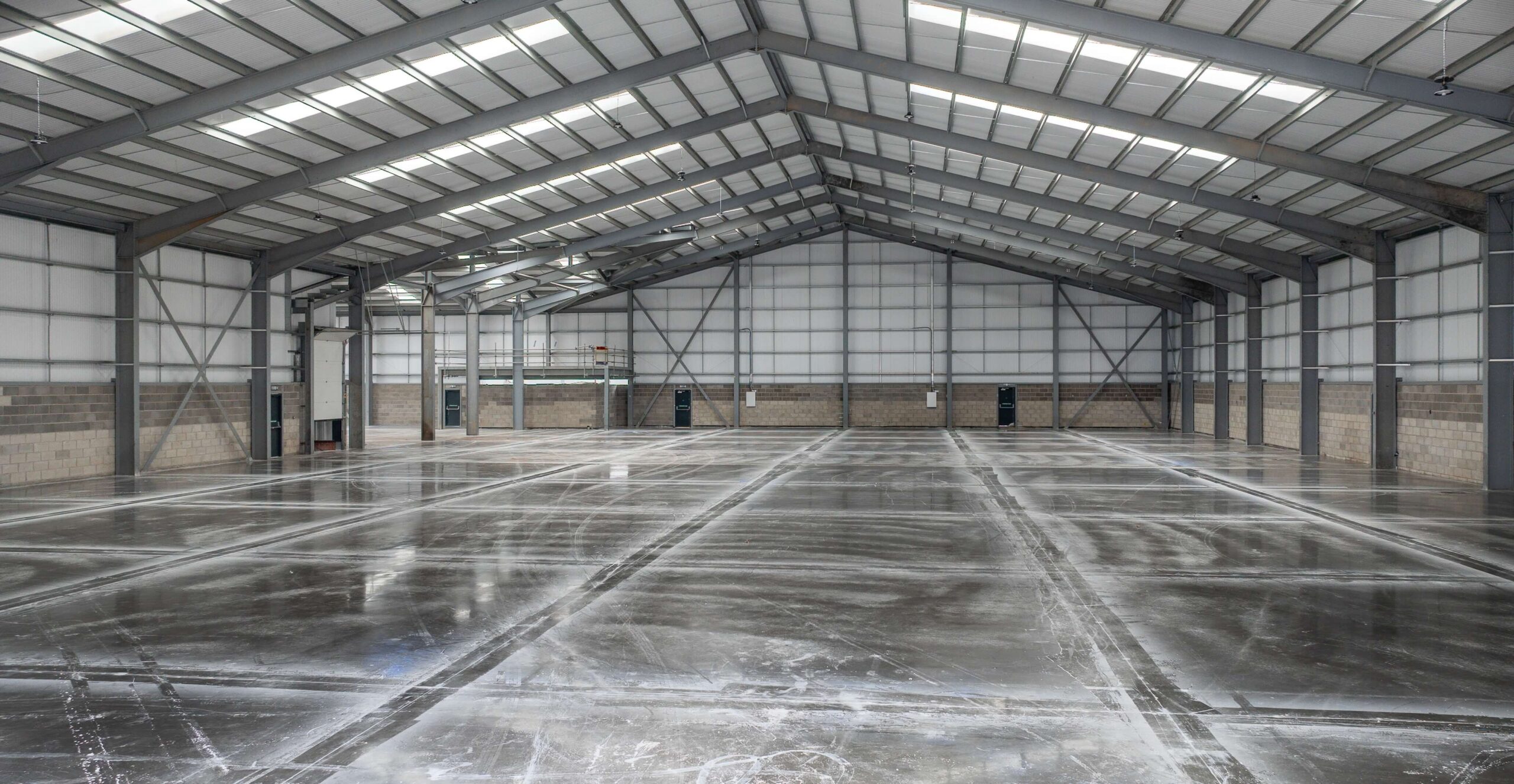
Ask two contractors what a polished concrete floor is and you will often get two different answers. One means a slab ground back with diamond tooling until it reflects the lights above it. The other means a power floated floor that has been trowelled to a hard, close grained sheen. They are not the same product, they are not installed by the same process, and they do not belong in the same buildings.
This guide sets out what each finish actually involves, where each one earns its place, and how to put the right one in your specification. Technic installs power floated and surface hardened industrial slabs rather than decorative polished floors, so where polishing is the better answer for your project, we will say so.
Key takeaways
- Polished concrete is ground and burnished after curing. A power float finish is trowelled into the slab during the pour.
- Power float is the industrial standard: no second trade, no extra programme, and better resistance to forklift traffic.
- Polished concrete belongs where the floor is looked at, not worked on: showrooms, retail units, offices and hospitality.
- Neither suits an external yard. Outside, a brush finish provides the skid resistance vehicles need.
- Both finishes are limited by the slab beneath them, so flatness, reinforcement and joints are decided long before the finish is.
What polished concrete actually involves
True polished concrete is a mechanical process carried out after the slab has cured. Diamond grinding heads work across the surface in progressively finer grits, cutting through the top layer of paste and exposing sand or aggregate depending on how deeply the first pass cuts. A chemical densifier is applied part way through the sequence, reacting with free lime in the concrete to harden the surface, and the final passes burnish it to the specified gloss level.
Three practical consequences follow from that:
- It is a separate trade and a separate visit. The slab is placed and cured first, then ground weeks later, usually once the building is watertight and other trades are clear.
- The finish depends entirely on the slab beneath it. Aggregate distribution, colour variation, service penetrations and any patching all become visible the moment the surface is opened up.
- Gloss level is specified, not assumed. A lightly ground matt surface and a mirror gloss are different amounts of work at very different prices.
Polished concrete earns its place where the floor is part of the interior: showrooms, retail units, offices, galleries and hospitality spaces. Our guide on how to polish concrete floors walks through the grinding sequence in more detail.
What a power float finish is
A power float finish is created while the concrete is still green, as part of the pour rather than after it. Once the slab has stiffened enough to take the machines, ride on or pedestrian power floats work the surface: first with float pans to close it and bring the paste up, then with finishing blades that trowel it progressively tighter. The result is a dense, closely knit, hard wearing surface formed from the concrete itself rather than applied to it.
Because the finish happens during construction, there is no second mobilisation, no additional programme and no waiting for the building to be ready. On large areas the slab is placed by laser screed to the required flatness classification and floated to the specified finish in the same continuous operation, which is how a warehouse floor of several thousand square metres is completed in a single day.
Where surface wear is the governing factor, a dry shake hardener can be broadcast onto the fresh concrete before the final float passes. This adds a dense layer of hard aggregate that resists abrasion from forklift tyres, dragged pallets and point loads, and it can be pigmented where a consistent colour or demarcation is wanted.
The two finishes side by side
| Polished concrete | Power float finish | |
|---|---|---|
| When it happens | After curing, as a separate follow on trade | During the pour, as part of floor construction |
| How it is produced | Diamond grinding, densifier, burnishing | Float pans and finishing blades on green concrete |
| Programme impact | Second mobilisation, needs a clear building | None, the floor leaves site finished |
| Relative cost | Higher, driven by gloss level and grinding passes | Included in the floor, a hardener adds a modest premium |
| Appearance | Decorative, reflective, aggregate exposed | Functional, uniform, close grained sheen |
| Wear resistance | Good, surface hardened by densifier | Very good, excellent with a dry shake hardener |
| Best suited to | Retail, showrooms, offices, hospitality | Warehouses, factories, distribution centres, workshops |
Choosing the finish by environment
Warehouses, distribution centres and production areas call for a power float, usually with a dry shake hardener where mechanical handling traffic is constant. The floor has to carry load, hold its flatness under racking and resist wear. Grinding adds cost without adding performance, and an exposed aggregate surface shows impact damage that a floated floor would shrug off. This is the case for most internal concrete flooring projects we are asked to price.
Trade counters, vehicle workshops and light industrial units also point to a power float. Oil, tyre marks, dropped tools and wheel impact are routine in these buildings, and a trowelled surface takes that treatment far better than a decorative one.
Retail units, showrooms, offices and hospitality spaces are where polished concrete makes sense. Traffic is pedestrian, appearance is the point, and the budget for a follow on grinding trade is usually already in the fit out package.
External yards, service roads and loading areas need neither. An external concrete floor is normally brush finished, because the texture provides the skid resistance that vehicles and pedestrians need in wet weather. A smooth trowelled surface outdoors is a hazard, not an upgrade.
Floors due to receive a covering are a fifth case. Here the finish only needs to meet the surface regularity the covering manufacturer specifies, so an easi float finish is normally correct. Polishing a floor that is about to be tiled or coated is money spent twice.
The slab decides what the finish can deliver
Both finishes are limited by the concrete underneath them. Flatness is set at placement and cannot be corrected by trowelling, which is why the classification is agreed at design stage and measured after construction. Our explainer on FM and FF flatness numbers covers how that is specified and verified. Shrinkage is controlled by reinforcement and by saw cut joints formed at the right time, depth and spacing, not by the surface treatment. Curing decides how hard that surface ends up, whichever route you take.
The 6,000 square metre floor at Huyton Trade Centre, Liverpool is a straightforward illustration: laser screed placement to the specified tolerance, power floated in the same operation, and in service under trade counter traffic without a grinding contractor ever setting foot on it.
In short
Specify polished concrete when the floor will be looked at. Specify a power float, with a dry shake hardener if the traffic warrants it, when the floor will be worked on. The mistake worth avoiding is paying for a decorative finish on a slab that will spend its life under a forklift, or accepting a purely functional finish in a space where the concrete is meant to be seen.
Frequently asked questions
Not sure which finish belongs in your specification?
Send us the drawings and the intended use. Technic has been designing and installing industrial concrete flooring across the UK for more than 40 years, and we will tell you honestly which finish your building needs.
Talk to our team or call 01942 679100.