
Every concrete floor is designed to a specified strength. Concrete cube testing is the only reliable way to prove that the concrete delivered and placed on your site actually reached it. Technic Concrete Floors arranges independent cube testing to British Standards on every pour we carry out, and offers the same service to main contractors, developers and engineers who need certified strength results for their own concrete works.

Join Our 80+ Companies Working With Technic


Cube Testing At
Technic Concrete Floors.
Samples are taken on site, cured under controlled conditions and crushed at an accredited independent laboratory at 7 and 28 days. You receive a certified compressive strength result for each pour, giving you documented evidence that the floor meets its design before racking, plant or finishes go in.
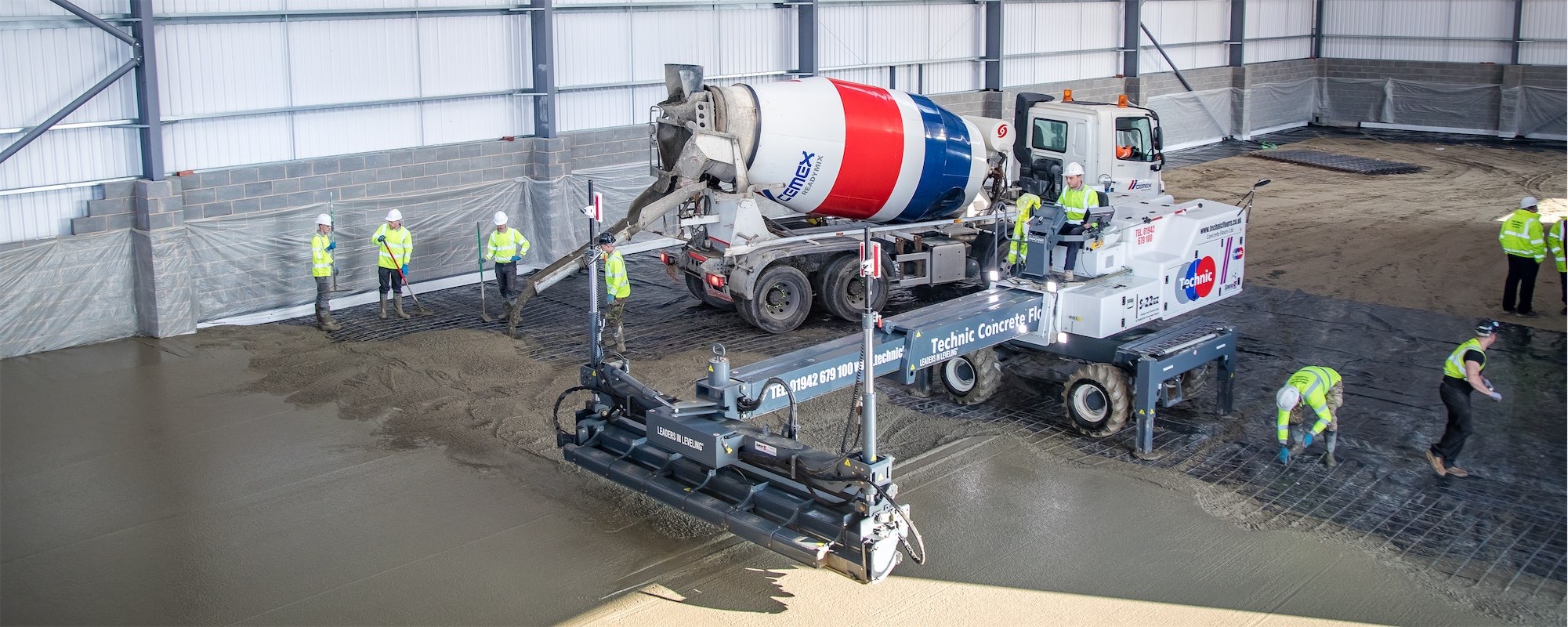
Cube testing is specified on almost every commercial and industrial concrete project, and it is a condition of most warranties and structural sign offs.

We provide the service for:
Test results are only as good as the laboratory that produces them. All Technic cube testing is carried out at an independent testing house accredited for the relevant British Standards, so the result you receive is impartial and will be accepted by engineers, insurers and building control without question.
Sampling, cube making and curing follow BS EN 12390-2, and compressive strength testing follows BS EN 12390-3. Mix specifications are checked against BS 8500 so the result is measured against the correct characteristic strength for the concrete class ordered.
BS EN 12390-2
Making and curing specimens for strength tests
BS EN 12390-3
Compressive strength of test specimens
BS 8500
Specification for concrete mix materials and design
Get In Touch.
Want to learn more or discuss your next project? Fill out the contact form or give us a call on 01942 679100
Concrete gains strength over time, so results are taken at fixed ages to show both early progress and the final specified strength. The process from delivery to certificate runs as follows.
1
A representative sample is taken from the concrete as it is delivered, in line with the sampling rate set in the specification. Each sample is logged against the pour, the mix reference, the supplier delivery ticket and the location in the floor.
2
The sample is compacted into standard 150 mm steel moulds in layers to remove air voids. A minimum of three cubes is cast per sample so that results can be checked against each other, with a spare cube available if a further test is needed.
3
Every cube is marked with a unique reference, the casting date and the pour it came from. Clear marking is what allows a result to be traced back to a specific area of the floor if a question ever arises.
4
Cubes are protected on site for the first 24 hours, then stored in a temperature controlled water tank at the laboratory until they reach test age. Correct curing is essential; a cube left drying on site will understate the strength of the concrete in the floor.
5
The first cube is crushed at 7 days. Concrete will typically have reached around two thirds of its 28 day strength by this point, so the 7 day result gives an early warning if strength gain is slower than expected.
6
The 28 day result is the reference age for the specified characteristic strength and is the figure that appears on the certificate as evidence of compliance. Optional tests at 14 and 56 days can be arranged where the specification calls for them.
Results are issued as a laboratory test certificate within a few working days of each test date. The certificate records the cube reference, the pour, the age at test, the failure load and the compressive strength in N/mm², alongside the specified strength for comparison.
If a result falls short, we tell you straight away rather than waiting for the 28 day report. Spare cubes, batch records and the affected area are reviewed together with the concrete supplier and the engineer to establish whether the floor still meets its design requirements or whether further investigation is needed. Early testing exists so that any issue is identified while options remain open.

40+
Over 40 years of concrete flooring experience
One point of responsibility
When the contractor placing the floor also manages the testing, samples are taken at the right moment and from the right loads. There is no gap between trades for a missed sample to fall into.
Over 40 years of concrete flooring experience
We know what results should look like for each mix and can interpret them in the context of the floor, not just the laboratory.
Complete records for handover
Test certificates are collated pour by pour and issued with the project documentation, ready for the client file and any future warranty enquiry.
Part of a full service
Cube testing sits alongside our steel fixing, laser screed and industrial concrete flooring services, so every stage of the floor is verified by the same team.
Recent projects where cube testing formed part of our quality assurance include the Huyton Trade Centre in Liverpool and works at Liverpool John Lennon Airport. Further examples are in our projects section.

Tell us the pour dates, the approximate volume of concrete, the specified mix and the sampling rate required by your engineer. We will confirm the number of cubes, the test ages and the cost, and arrange for samples to be taken on the day. For floors we are placing ourselves, testing is scheduled automatically as part of the programme.
Call 01942 679100, email info@technicfloors.co.uk or complete the enquiry form and a member of the team will come back to you the same working day.
Need certified strength results for your concrete?
Independent 7 and 28 day cube testing to British Standards, arranged and reported by Technic Concrete Floors. Call 01942 679100 or request a quotation.
Random samples of the concrete supplied to site are cast into 150 mm moulds, cured in a controlled tank, and then crushed under compression at set ages. The force at failure confirms the compressive strength actually achieved, verifying that the supplied concrete matches the engineer’s specification. For a fuller explanation of the method and what the results mean, read our guide to what concrete cube testing involves.
Concrete gains strength progressively. The 7 day result gives an early indication that strength gain is on track, while the 28 day result is the standard reference age at which the specified characteristic strength must be met.
All testing is carried out in accordance with British Standards at an independent, accredited testing house, giving contractors and clients impartial evidence of quality.
A failed result is investigated immediately: remaining cubes, supplier batch records and the affected pour are reviewed to establish whether the slab meets design requirements or remedial action is needed. Early testing exists precisely so that issues surface before they become expensive.
That depends on the sampling rate in the specification, which is usually expressed as one sample per fixed volume of concrete or per day of pouring. Each sample produces at least three cubes. We confirm the number when you book.