
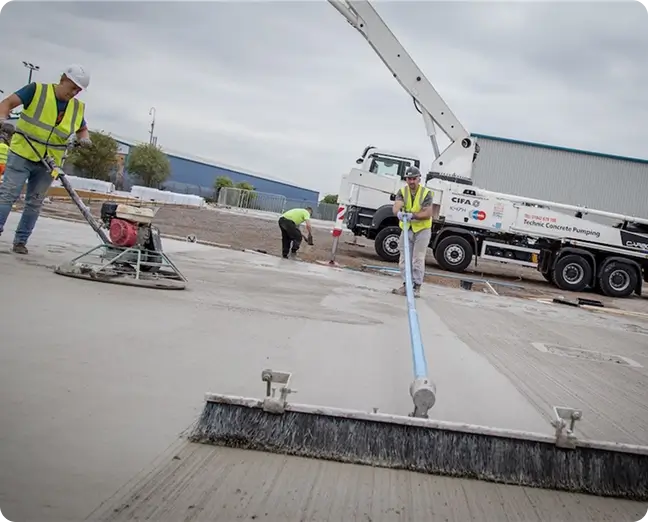
A British summer rarely brings sustained heat, but even a few warm, dry, breezy days are enough to change how a concrete pour behaves. Curing, the process of keeping a slab at the right moisture and temperature while the cement reacts and gains strength, is often treated as an afterthought once the finishing trowels have gone away. In warm weather that is a mistake. The same conditions that make a pour comfortable to work in also pull moisture out of the slab far faster than the concrete can manage on its own, and the results show up as cracking, dusting and a surface that never quite reaches its design strength.
This guide sets out what curing actually does, why warm weather makes it harder to get right, the mistakes that cause the most damage, and the practical steps that protect a slab through a summer pour.
What curing actually does
Concrete does not simply dry out and harden. The cement in the mix reacts chemically with water in a process called hydration, and this reaction continues for weeks after the concrete has been placed. Strength, durability and surface hardness all depend on hydration continuing for long enough before the slab is allowed to dry.
Curing is the practice of controlling moisture loss and temperature so that hydration can carry on properly. If the surface of the slab dries out too quickly, hydration near the top stops while the concrete underneath is still developing, leaving a weaker, more porous surface layer that is prone to dusting and abrasion damage. Get it wrong and the damage is largely permanent, since no amount of curing after the fact can undo moisture lost in the first hours.
Get curing right and the slab reaches close to its specified strength with a durable, even surface.
Why warm weather makes curing harder
Three factors combine in warm weather to increase the rate at which a fresh slab loses moisture: air temperature, wind, and low humidity. Any one of these on its own is manageable. Together, particularly on an exposed site with a breeze blowing across an open slab, they can strip surface moisture within an hour or two of placement, long before the concrete has gained enough strength to resist it.
The most visible consequence is plastic shrinkage cracking. This happens while the concrete is still plastic, before it has properly set, when the surface dries and shrinks faster than the concrete beneath it. The result is a network of fine, random cracks across the surface, often appearing within hours of placement. Beyond cracking, rapid drying also causes crazing (a web of very fine surface cracks), reduced surface hardness, and dusting once the floor is in use. None of these are cosmetic issues that settle down over time. They reflect a surface that did not cure properly and will continue to perform below its intended standard.
Warm weather also speeds up setting times generally, which compresses the window available for finishing operations such as power floating. A crew working to a finishing schedule calculated for cooler conditions can find the concrete has gone off before the surface work is complete, leading to an uneven or poorly compacted finish.
Common curing mistakes in warm weather
Most curing problems trace back to a small number of avoidable mistakes, each with consequences that are expensive to fix once the concrete has hardened.
Leaving the slab exposed after finishing. Once power floating or other finishing work is complete, every minute the surface is left uncovered in warm, breezy conditions is moisture lost. Curing measures need to be in place as soon as the surface can tolerate them, not at the end of the working day.
Spraying water directly onto the surface. Hosing down a curing slab seems like an obvious fix for a drying surface, but applying water directly can wash out fines, cause blotching and surface discolouration, and create an inconsistent cure across the floor. Any water-based curing method needs to maintain a constant film of moisture, not an intermittent soaking.
Using torn, loose or poorly sealed sheeting. Polythene sheeting is one of the most common curing methods because it is cheap and effective, but only if it forms a continuous seal across the slab with the edges weighted or taped down. Gaps, tears or sheeting that lifts in the wind create localised dry patches that cure unevenly compared to the rest of the floor.
Pouring at the hottest, windiest part of the day without adjusting the plan. A pour timed for convenience rather than conditions can put fresh concrete straight into the worst possible drying environment. Shifting the pour to early morning, arranging temporary windbreaks, or having curing materials ready to apply the moment finishing allows it can make the difference between a sound floor and one with visible cracking by the following morning.
Treating curing as a single, short task. Concrete needs protection for considerably longer than most site teams assume, often a week or more for the surface to develop enough resistance to normal wear. Removing covers or curing compounds too early exposes a surface that is still vulnerable.
Practical methods for curing a slab in warm weather
There is no single correct method, and the right choice depends on the size of the pour, the finish specified and how the floor will be used. The principle behind every method is the same: minimise moisture loss from the surface for long enough that hydration can continue.
Curing compounds. A sprayed-on membrane forming compound is applied to the surface shortly after finishing and forms a thin film that slows evaporation. This is one of the most practical methods for large floor areas, since it can be applied quickly across the whole slab without the labour involved in placing and maintaining coverings. The compound needs to be applied evenly and at the correct coverage rate, and care should be taken that it does not interfere with any subsequent finishes or coatings.
Wet curing with hessian or sacking. Damp hessian laid directly onto the surface and kept consistently moist provides effective curing, particularly in hot conditions where evaporative cooling also helps control the slab temperature. The drawback is that it needs regular re-wetting, which means site labour for the full curing period, and it must not be allowed to dry out and then be re-wetted intermittently, since that creates the uneven curing described above.
Polythene sheeting. Sheeting traps moisture rising from the slab and prevents it escaping into dry air. It is low cost and widely used, but only works if it is sealed at every edge and weighted down against wind. On a windy site, sheeting that is not properly secured can do more harm than good by lifting intermittently and allowing localised drying.
Timing the pour. Where conditions allow, placing concrete in the early morning or evening avoids the highest temperatures and strongest winds, giving the slab a calmer environment in the hours when it is most vulnerable. Windbreaks or temporary shading around an exposed slab edge can also reduce the drying effect significantly.
Fogging. A fine water mist applied above the surface, rather than directly onto it, raises humidity around the slab without disturbing the finish. This is most useful in the period immediately after placement and before other curing measures, such as a compound or sheeting, can be applied.
Anyone handling curing compounds or working with fresh concrete should also be aware of the skin and respiratory hazards that wet cement and concrete dust present. The Health and Safety Executive publishes guidance on the precautions needed when working with cement-based products.
Curing is part of the wider programme, not an afterthought
Curing decisions are easier to get right when they are planned before the pour rather than improvised on the day. Knowing the weather forecast, having curing materials on site in advance, and agreeing who is responsible for applying and checking curing measures should all be settled during pre-construction planning, alongside the other details that determine how a slab performs.
The standard a floor is cured to also connects directly to other parts of the specification. A slab that has not cured properly is more likely to develop the random cracking that concrete saw cutting is designed to control, because uneven shrinkage at the surface disrupts the planned joint pattern. Curing also affects the results from concrete cube testing, since cube samples need their own controlled curing to give a true reading of the strength the in-situ slab has achieved. And a floor that has cured well is far more likely to meet the flatness and surface tolerances covered in our guide to concrete floor flatness standards, since drying-related distortion and curling can quietly take a slab outside its specified tolerance after it has been signed off.
Whether the pour is for internal concrete flooring inside a warehouse or unit, or external concrete flooring such as a yard or hardstanding exposed to direct sun and wind all day, curing in warm weather deserves the same attention as the pour itself.
Frequently asked questions
How long does a concrete floor need to be cured?
Most specifications call for a minimum of seven days of curing, though the exact period depends on the cement type, the mix design and the ambient temperature. Warmer conditions can mean the concrete gains strength faster, but the surface is also drying faster, so curing measures generally need to stay in place for at least as long, if not longer, than they would in cooler weather.
Can concrete be poured in hot weather in the UK?
Yes, and large pours regularly take place during the warmer months. The key is planning around the conditions rather than ignoring them: adjusting pour times, having curing materials ready before placement begins, and protecting the slab the moment finishing allows. Problems arise when a summer pour is treated the same as one in cooler, calmer conditions.
What happens if a concrete floor dries out too quickly?
The most common result is plastic shrinkage cracking, a pattern of fine random cracks that appears on the surface within hours of placement. Rapid drying can also cause crazing, a weaker and more porous surface layer, and dusting once the floor is in use. These issues are very difficult to fully remediate after the concrete has hardened.
Do small pours need the same curing care as large warehouse slabs?
The principle is the same regardless of size: the surface needs to retain moisture for hydration to continue. Smaller pours can actually be more vulnerable to rapid drying, because they have a higher surface area relative to their volume and heat up and dry out more quickly than a large, deep slab.
Talk to us about your pour
Getting curing right starts well before the concrete arrives on site. If you are planning a pour for the warmer months, our team can talk through the programme, the conditions on your site and the curing approach that suits your floor.